
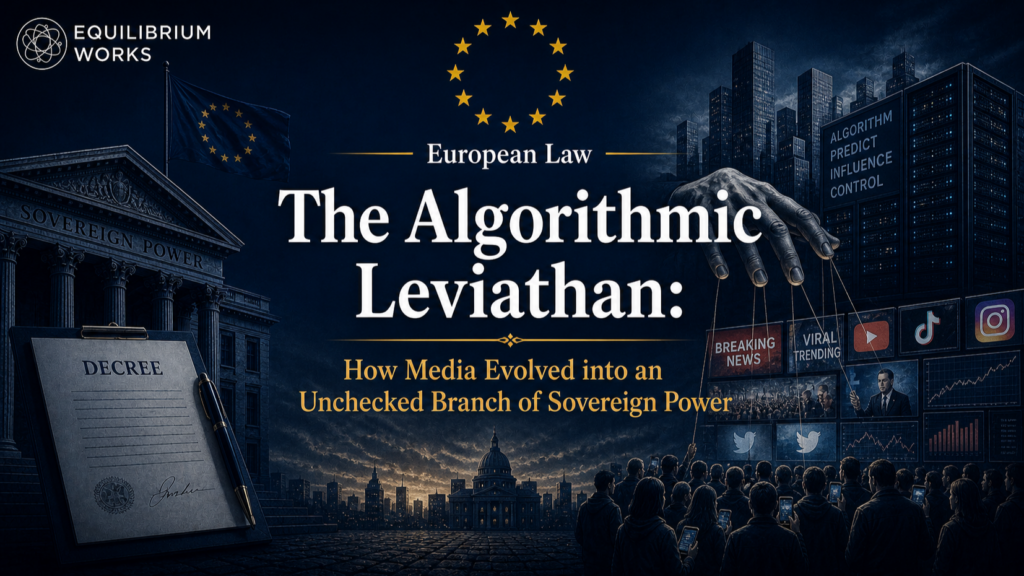
For centuries, the foundation of democratic statecraft has rested upon the classical separation of powers. We are taught to view governance through the tripartite lens of the executive, the legislative, and the judiciary. However, as we continue our rigorous analysis of contemporary systemic decay, we must confront a structural reality that renders this traditional model dangerously obsolete.
There is a new, ubiquitous pillar of governance that does not draft legislation, adjudicate legal disputes, or command military forces, yet it holds the capacity to dictate the outcomes of all three. In this edition of our research series, we explore the rise of the “Media Branch of Power” and the mechanics of algorithmic manipulation. By moving beyond the archaic view of media as a mere communication tool, we uncover how highly personalized, complex digital ecosystems have weaponized human psychology to shape public conviction without any democratic oversight.
The Redefinition of Sovereignty: Media as a Branch of Power
To conceptualize the gravity of modern digital media, we must pivot to the theoretical framework of legal scholar Béla Pokol. As early as 2006—a time when the internet was not yet the omnipresent household infrastructure it is today—Pokol argued that media functions as a distinct branch of power.
This is not a metaphorical classification. According to Pokol, this media branch is of equal or even superior importance to traditional executive authorities, such as the President of the United States. The structural logic behind this assertion is profoundly simple yet chilling: while the traditional branches of government exercise their authority over the citizenry through laws and bureaucratic enforcement, the media acts directly upon the ultimate source of every kind of power: the individual.
In a functioning democracy, the individual’s conviction is the genesis of legal and political legitimacy. By controlling the informational and emotional environment in which that conviction is forged, the media bypasses traditional constitutional guardrails entirely. It possesses tools capable of creating mass awareness and fundamentally changing public conviction from the ground up.
The Psychometric Architecture of Algorithmic Manipulation
What Pokol identified in the era of traditional broadcast media has been exponentially amplified by modern digitalization and artificial intelligence. The digital platforms we interact with daily are no longer passive content aggregators; they are active, psychometric architectures.
Today’s social media algorithms create highly granular psychological profiles of every single individual. To achieve this, the world’s best neuroscience specialists and psychologists have been absorbed by these tech companies, engineering systems that project textual and video content specifically designed to foster engagement and trigger desired emotional reactions.
The data inputs feeding these algorithms are staggeringly invasive and deeply personal. They calculate a user’s trajectory based on various factors, ranging from immediate mood and actual location to local precipitation levels. They ingest data from private conversations with friends, visited websites, and even deep-seated psychological vulnerabilities, such as a user’s relationship with their parents and their childhood traumas.
The sheer subtlety of this manipulation makes it extraordinarily dangerous. This is not a system of overt propaganda or mass awareness in the traditional sense; it is a system capable of shaping public opinion in ways so subtle that it bypasses logical cognition. If you use it for an hour, the algorithm could ensure that you go to a shop and buy a pack of tea a week later, without ever having shown you a direct advertisement or any depiction of tea.
In a more profound socio-political context, the manipulative power is absolute. A media ecosystem so powerfully personalized possesses the capacity to make an animal welfare activist turn into a proud butcher in less than a month, given the right algorithmic settings.
Capital Consolidation and Toxic Directives
The danger of this unregulated branch of power is severely compounded by the unprecedented concentration of capital that sustains it. As noted in our ongoing structural analyses, financial power concentration in the hands of a few is the easiest type of power to acquire, and this is entirely valid for digital media.
Mega-platforms, such as Meta or TikTok, are co-owned by shareholders who wield a virtually unassailable combination of advantages: immense financial power, cutting-edge technological infrastructure, and overlapping shares that allow for coordinated influence across multiple global entities. Because these platforms are geographically fluid, they can become detachable from their physical owners or sovereign jurisdictions in the split of a second, evading national legal constraints.
When these corporate ecosystems interface with political entities or ideological movements, the results are deeply corrosive to democratic deliberation. These complex systems are increasingly supervised by politics and led by highly simplified directives. These directives are rarely rooted in nuance; they are retrieved from the purposeful, often distorted interpretation of legal and social principles—such as gender equality—rather than an interpretation grounded in their actual societal purpose.
State and corporate actors effectively take these toxic interpretations and upload them into the most complex cognitive systems on earth. The objective is to make these simplified directives aggressively appealing and engaging for the maximum amount of people. The algorithms achieve mass compliance not through uniform broadcasting, but by conveying the same overarching information through “planting different seeds” in different brains at distinct moments. These highly individualized inputs inevitably grow into the exact same homogenized political conviction, resulting in the desired collective behavior.
Cross-Relation: Cognitive Dissonance and Demagogy
This algorithmic manipulation is the precise engine driving the political demagogy we discussed in our earlier analyses regarding cognitive dissonance.
When media prioritizes hyper-personalized emotional engagement over genuine, logical understanding, the socio-political system becomes unintelligibly complex and full of noise. The algorithm structurally forces the public and political discourse further away from each other. Because the public’s conviction of reality is continuously warped by these deeply targeted digital inputs, an impossible dissonance emerges between the people’s real, lived experiences and the political interpretation of reality. This gap is the exact breeding ground for populism and demagogy, allowing political actors to exploit an audience that has already been psychologically conditioned by the algorithmic media branch.
The Void of Institutional Oversight and Societal Lag
Perhaps the most alarming aspect of the algorithmic media branch is its total lack of institutional oversight. These platforms operate continuously, modifying human behavior at an industrial scale, yet they are generally considered “safe” and are used voluntarily by billions. Because these systems operate via psychological nudging rather than explicit coercion, the problem passes largely unnoticed by the public—even by those who are actively suffering from its cognitive consequences.
We are facing a profound chronological crisis. Technology is evolving at a blistering pace in parallel with a society that is drastically lagging behind. As this gap widens, it will become increasingly—perhaps impossibly—costly to change the course of this process. We are yielding our cognitive sovereignty to a system that is highly intelligent, understanding, and dedicated to its programming, but fundamentally detached from democratic accountability.
It is already impossible to undo the cognitive and political alterations these systems have achieved globally. The ultimate tragedy of this architectural shift is that humanity will not have any legal or technical tools to extract the essential data needed from these black-box systems to stage an intervention or enforce a correction.
Conclusion: Recognizing the Leviathan
We can no longer afford to analyze political science, jurisprudence, or sociology without formally recognizing the Media as a dominant, independent branch of sovereign power. It does not act as a mere mirror to society; it acts as an unchecked psychological architect.
By utilizing highly personalized algorithmic manipulation to create psychological profiles, project behavior-altering content, and deploy toxic directives without explicit advertisements, modern digital media has usurped the foundational source of democratic power: the individual’s free conviction.
Until constitutional law and global regulatory frameworks evolve to structurally classify and oversee these algorithmic ecosystems as state-level power actors, traditional democracies will remain vulnerable to a form of silent, psychometric absolutism from which there is no organic recourse.
Academic Bibliography
- Zuboff, Shoshana. The Age of Surveillance Capitalism: The Fight for a Human Future at the New Frontier of Power. New York: PublicAffairs, 2019.
- Pokol, Béla. Médiahatalom (Media Power). Budapest: Századvég, 2004.
- Chadwick, Andrew. The Hybrid Media System: Politics and Power. Oxford: Oxford University Press, 2017.
- Sunstein, Cass R. #Republic: Divided Democracy in the Age of Social Media. Princeton: Princeton University Press, 2017.
- O’Neil, Cathy. Weapons of Math Destruction: How Big Data Increases Inequality and Threatens Democracy. New York: Crown Publishing Group, 2016.
- Vaidhyanathan, Siva. Anti-Social Media: How Facebook Disconnects Us and Undermines Democracy. Oxford: Oxford University Press, 2018.